Responsible Gambling Tools for UK UFC Round Bettors
 Available in US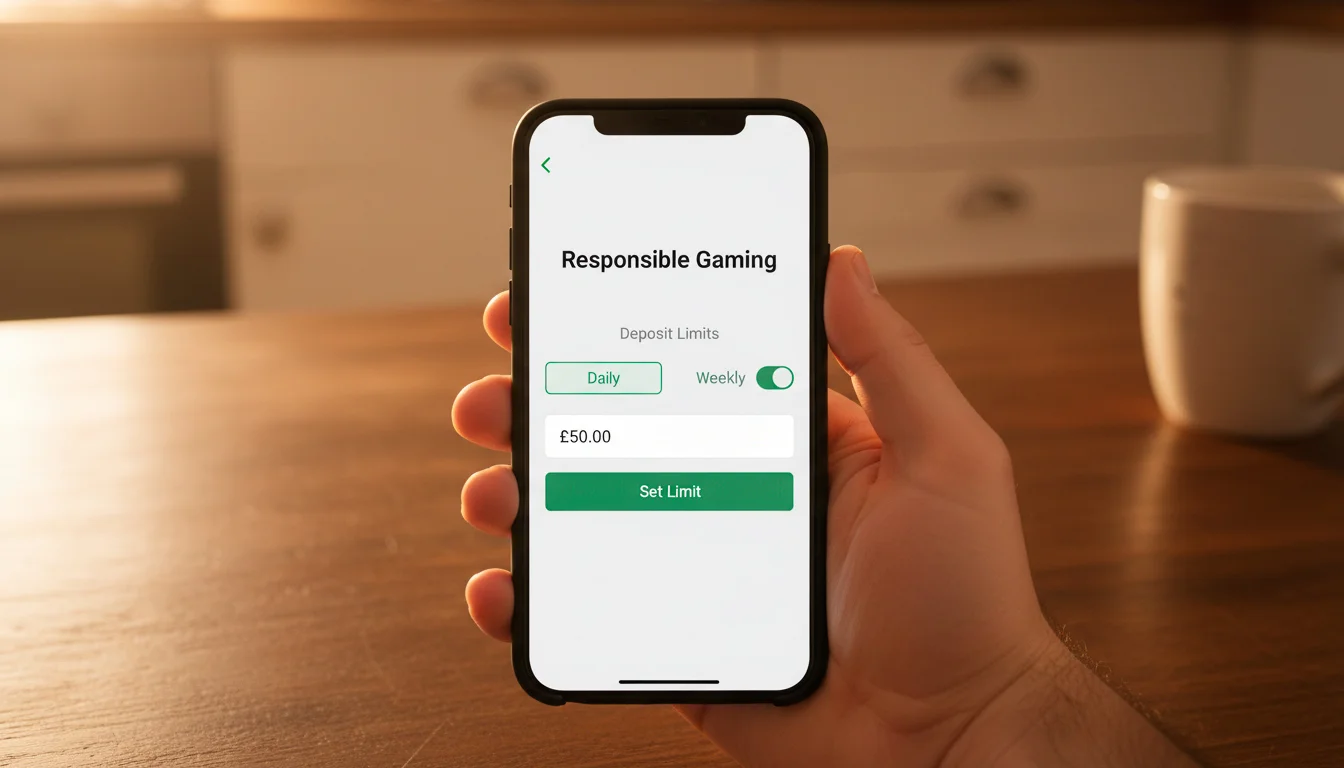
The infrastructure that keeps the hobby a hobby
Round betting is supposed to be entertainment. For most UK punters, most of the time, it is. The tools I want to talk about here are the ones that exist specifically to keep it that way — the deposit limits, the time-out features, the self-exclusion options, the reality checks — and the support networks that exist for the moments when betting stops being entertainment and starts being something else.
I use several of these tools myself even though I have never had a problem gambling issue. Deposit limits are not only for people in trouble. They are for anyone who wants to place a useful cap on how much of their monthly budget can go through the bookmaker, and they are a discipline that keeps a hobby sized appropriately. As Andrew Rhodes, then Chief Executive of the UK Gambling Commission, noted, “it is early days but GamProtect has already identified over 6,000 consumers, helping protect them from risk and serious harm”, which is the kind of sentence that underlines how seriously the UK regulatory framework takes the infrastructure now.
This piece walks through the specific tools available to UK UFC round bettors, what each does, and when to think about using them. The tone is practical rather than lecturing. The goal is that you understand the tools as options rather than as warnings.
GamStop: the full-exclusion option
GamStop is the UK’s national self-exclusion scheme. When you register, you are excluded from all UKGC-licensed online gambling operators for a period you choose — six months, one year, or five years minimum. The exclusion applies across every licensed operator simultaneously, so you cannot simply open a new account at a different bookmaker to bypass it.
Registration is free, takes about ten minutes, and requires basic personal details plus confirmation of what you want to exclude from. Once active, any attempt to log into a UKGC-licensed gambling site with your registered details will be blocked. The exclusion cannot be lifted before the chosen period ends — that is the entire point of the scheme, to create a commitment device that cannot be undone in a moment of impulse.
GamStop is the serious tool for the serious situation. It is not for trimming bet volume or taking a break. It is for the bettor who has recognised that their relationship with gambling has become unhealthy and who wants to remove access as completely as the UK regulatory framework allows. If that describes you, GamStop is effective and the registration process has been streamlined enough that friction is minimal.
The complement to GamStop is the restriction on non-UKGC sites that have been expanding their enforcement footprint. The UK Gambling Commission has issued more than 770 cease-and-desist notices against unlicensed gambling operators since April 2024, with 64,000 URLs removed and 264 sites taken down. The practical effect for a GamStop user is that the workarounds via unlicensed sites that used to exist have become measurably harder to find.
Deposit and loss limits
Every UKGC-licensed operator offers deposit limits and loss limits as standard account settings. Deposit limits cap how much you can fund the account in a given period — daily, weekly, or monthly. Loss limits cap net losses across a period. Both are set by you, both are enforced by the operator, and both can be adjusted upwards only with a cooling-off period of at least 24 hours.
The point of the cooling-off period is to prevent the very specific failure mode of raising the limit in the heat of a chase or a tilt. You decide you want a higher limit, you submit the request, and 24 hours later the request is processed. If you still want the higher limit a day later, it is usually a considered decision. If you have forgotten about it or changed your mind, the original limit stays in place. Reducing limits is instant, raising them is delayed — this asymmetry is deliberate and useful.
I keep deposit limits on my accounts at a level calibrated to what I consider my entertainment budget. The limits are not triggered in normal months. They would be triggered if I ever tried to fund a chase after a bad losing card, and that is exactly the moment when the limit serves its purpose. Setting them once and forgetting them is the discipline, and the limits quietly do their work without interfering with normal betting activity.
Stake limits on online slots are worth mentioning even though they do not apply to UFC round betting specifically. The UK introduced stake limits of £5 per spin for users aged 25 and above (from 9 April 2025) and £2 per spin for users under 25 (from 21 May 2025). These are specific to slots and do not limit sports betting stake size, but they are part of the broader regulatory pattern of building hard constraints into the gambling infrastructure.
Reality checks and timeouts
Reality checks are periodic pop-ups or notifications that tell you how long you have been logged in and how much you have staked in the current session. Every UKGC-licensed operator offers them, and the default on new accounts is usually an hourly reality check. You can set them to more frequent intervals if you prefer — every 30 minutes, every 15 minutes — or disable them entirely.
The purpose of reality checks is to interrupt the flow state that sustained betting activity can produce. A session that feels like it has been 20 minutes might have actually been two hours, and the reality check forces a brief pause to acknowledge the actual time and stake totals. Most bettors dismiss them reflexively, which defeats the purpose, but on the occasions when the session genuinely has gone longer than planned, the notification is useful.
Timeouts are the short-term cousin of GamStop. You can self-exclude for 24 hours, 48 hours, one week, or one month from a specific operator without triggering the full GamStop scheme. Timeouts are the right tool when you want a break rather than an exit, and they are granular enough that a single bad fight card that left you tilted can be followed by a week-long operator-level timeout while the rest of your betting activity continues normally elsewhere.
The reality-check and timeout combination is the lighter-weight version of the discipline that GamStop represents. Both are free, both are built into the account interface, and both can be activated or deactivated in a few taps. The bettor who uses them proactively tends to maintain a healthier long-term relationship with the activity than the bettor who treats all the responsible-gambling tools as only for other people.
Support networks and when to reach out
If your gambling has moved beyond the realm where tools alone are sufficient, the UK has a network of support services specifically for gambling-related issues. GamCare operates the National Gambling Helpline on 0808 8020 133, which is free, 24 hours, and staffed by trained advisers. The Helpline provides information, signposts to local support, and offers one-on-one conversations with people in need of a more personal response.
BeGambleAware is the UK charity that funds gambling-harm research and awareness, and their website hosts directories of local face-to-face counselling services, online support groups, and self-help resources. The threshold for engaging with any of these services is low — you do not need to have hit a crisis point to benefit from a conversation, and many of their users are people catching problems early rather than in extremis.
The GamProtect data-sharing initiative that Andrew Rhodes referenced has identified over 6,000 high-risk consumers, giving you a sense of the scale of the proactive identification work happening within the UK gambling framework. Operators now have well-developed algorithms, policies, and interaction protocols that identify behavioural patterns associated with risk before the user identifies them themselves. That infrastructure is on your side.
Reaching out for support is not a failure. It is the correct response to the specific situation where self-applied tools have not been enough and a conversation with someone trained to help is the right next step. The tools discussed above are effective for most bettors most of the time. For the situations they cannot handle, the support networks exist precisely for that reason.
The attitude that keeps the hobby sustainable
Round betting on UFC is a hobby I enjoy, and I want to keep enjoying it across many years rather than burning through my interest in a short period of undisciplined activity. The tools described in this piece are the infrastructure that makes long-term sustainability possible. Deposit limits keep the budget in check. Reality checks interrupt flow states. Timeouts provide pressure-release valves when a specific card has left me tilted. GamStop sits in reserve for the situation I hope never to need it for.
Using the tools is a choice. The choice is between treating gambling as a casual hobby with built-in guardrails and treating it as an unmanaged activity with no guardrails beyond your own willpower. The first approach is durable. The second is the approach that feeds the statistics the UKGC collects and worries about. There is no shame in using the guardrails. There is only forethought.
Is GamStop free?
Yes, registration for GamStop is completely free. The scheme is funded through the UK gambling industry’s regulatory framework rather than by individual users. Registration takes about ten minutes, applies immediately across all UKGC-licensed online gambling operators, and cannot be lifted before the chosen exclusion period ends — which is the entire mechanism that makes GamStop effective as a commitment device.
Can I set deposit limits specifically per fight card?
Not directly. Deposit limits at UK-licensed operators work on daily, weekly, or monthly cycles rather than on per-event bases. If you want a specific cap for a particular UFC card, the practical approach is either to set a weekly limit sized to your intended card budget, or to use the timeout feature to lock yourself out of the account for periods other than the card you are focusing on.
Do UKGC books alert me on chasing-loss behaviour?
Yes, increasingly so. UKGC-licensed operators now run automated behavioural analytics that identify patterns associated with gambling harm, including chasing losses. When those patterns are detected, operators issue in-app messages, reduce promotional offers to the user, and in some cases proactively contact the user to discuss their recent activity. The GamProtect initiative has identified over 6,000 high-risk consumers using this kind of cross-operator data sharing.
Created by the ”Round Betting ufc” editorial team.