UFC Apex vs Arena: Does Venue Actually Shift Round Outcomes?
 Available in US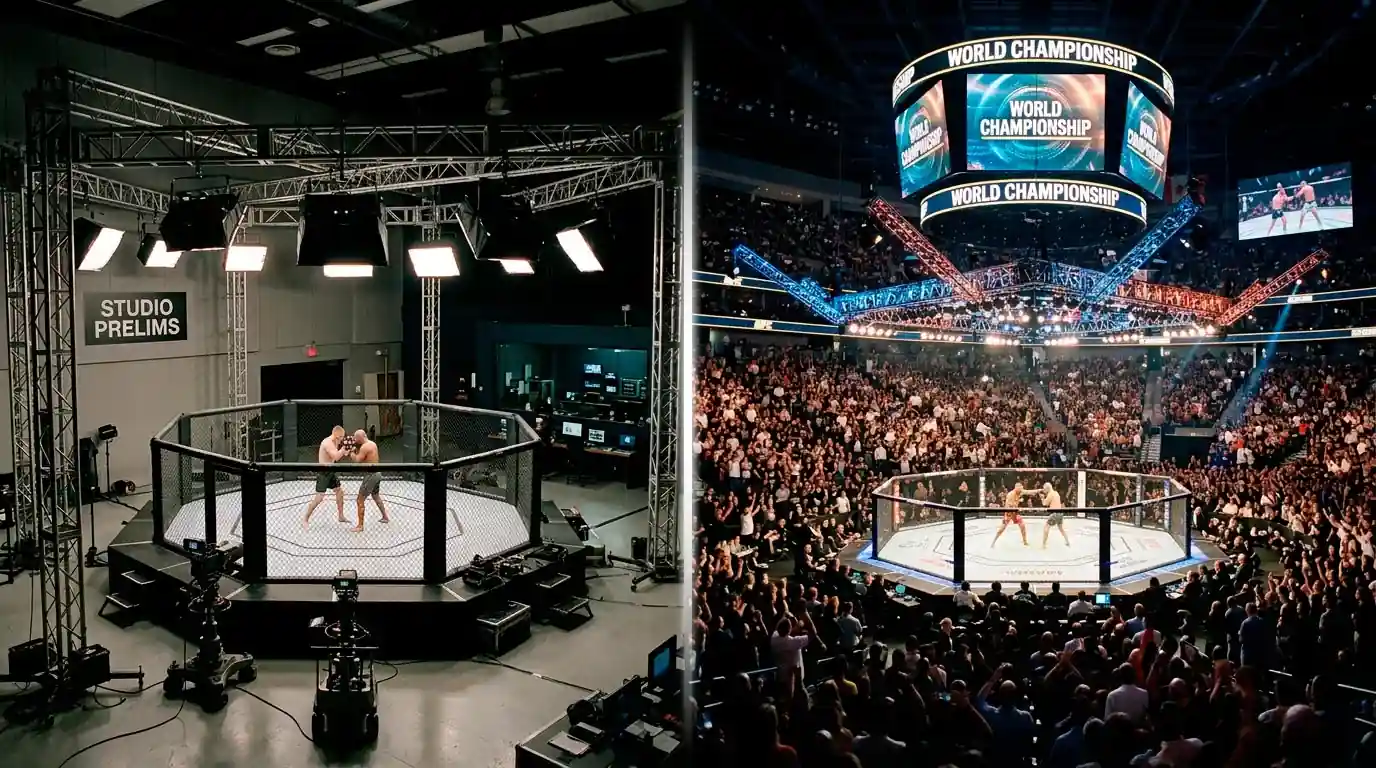
The venue question that took me years to answer seriously
For the first few years the UFC Apex was a regular fixture on the calendar, I treated the “Apex effect” as something bettors talked about at pubs but nobody actually modelled. Smaller cage. Quieter atmosphere. Different judges. Different outcomes? Everyone had an opinion. Hardly anyone had data. Then the aggregated finish data started coming out in 2024 and 2025, and it turned out the folklore was half right and half wrong in a specific and useful way.
The short version is this. UFC Apex has a higher stoppage rate than arena events, but the difference is almost entirely driven by submissions. KO and TKO rates are nearly identical between venues. If you have been shading every Apex fight shorter on a KO combo because “the cage is smaller and fighters can’t run”, you have been making a bet the underlying data does not support.
This piece walks through what the venue data actually says, where it could plausibly influence round pricing, and where it almost certainly should not. If you also want the broader division-by-division context, the finish rates calibration table gives you the baseline rates that Apex-versus-arena is shifting against.
The context of Apex as a UFC venue
The UFC Apex opened in 2019 as a dedicated event space on the UFC’s Las Vegas campus. It seats about 130 guests in its fight-night configuration, has a smaller cage option at roughly 25 feet across compared with the 30-foot cage used at most arena events, and hosts a steady stream of Fight Night cards alongside larger arena bouts at T-Mobile Arena and elsewhere. The Apex has a specific vibe — quieter, cooler, more clinical — and fighters have been open about how it feels different to compete in.
Interestingly, although the smaller cage is the best-known physical difference, the Apex also operates the 30-foot cage for some of its cards. When analysts aggregate Apex data, they are sometimes conflating “events in the Apex building” with “events in the smaller cage”, and those are not the same thing. The venue effect studies I trust most distinguish the two where possible, but much of the publicly available comparison data bundles them together under “Apex events”.
Against that, arena events cover the high-visibility Pay-Per-View cards and most Fight Nights held outside Las Vegas. The fighter list has shifted back towards arenas more heavily since 2023, which is worth keeping in mind when looking at Apex sample sizes — the recent era data is thinner than the full Apex era suggests.
The submission-rate gap
This is the core of the Apex effect. Apex events show a higher submission finish rate than arena events, and the gap is large enough to be meaningful rather than noise. The effect shows up across weight classes and across the multi-year Apex sample, which makes it unlikely to be purely a scheduling artefact.
The intuitive explanation is a mix of cage size and fighter-level composition. The smaller cage when used compresses grappling exchanges, giving the offensive grappler fewer escape angles and more opportunities to finish from dominant position. The fighter-list effect is that Apex cards tend to feature more newer and less-established fighters, who are on average less defensively polished on the ground than the seasoned veterans who fill arena main events.
What the data does not clearly show is whether the gap is driven more by the cage or more by the fighter quality. Honest statistical work on this question lands in “probably both, but we can’t cleanly isolate” territory. For round bettors, the practical implication is more important than the causal story — Apex cards price sub lines that should be shaded shorter, and sub-by-round combos are more likely to land at Apex than at arena events with the same matchup on paper.
KO rate parity and why it matters
If submissions rise at Apex, you might expect KOs to rise too — smaller cage, less space to retreat, more trading at range. The data does not support this. KO and TKO rates at Apex and arena events are nearly identical after controlling for weight class and fighter quality. The folklore that Apex fights are “more violent” is wrong as a generalisation.
This matters because plenty of casual round bettors instinctively shade KO-by-round lines shorter at Apex, assuming the smaller cage produces more finishes across every method. The data says otherwise, and the bettor who fades that instinct — by being willing to back longer KO prices at Apex — is taking a modestly positive-expectation view that the market sometimes prices against.
The one genuine KO-adjacent venue effect I have observed is that Apex fighter walkouts are shorter and the fighters step into the cage slightly cooler than at arena events where the entrance ritual is longer. Some analysts have suggested this produces a mild effect on round-one finishing intensity. The signal is small, and I would not stake on it alone, but it belongs in the “possibly real, hard to isolate” category.
Venue in your round model
The way I use Apex-versus-arena in actual pricing is straightforward. I add a small positive adjustment to submission probability for Apex bouts — typically 2 to 4 percentage points on the raw submission rate — and I leave KO probability untouched unless the specific match-up has another reason to skew it. The overall finish rate rises slightly as a result, which flows through to a modestly shorter fair price on over-under rounds and a modestly shorter fair price on sub-by-round combos.
I do not shade KO-by-round lines for Apex at all. If the match-up is a striker-versus-striker bout that looks like a violent finish waiting to happen, the venue does not change that read. If the match-up is a grappler-versus-striker with the grappler holding a realistic submission path, Apex nudges the sub probability a fraction higher.
The academic submission data already tells us that intermediate weight divisions record higher submission finishes. Apex cards skew towards intermediate weight divisions because those divisions have deeper rosters and more Fight Night cards. The composition effect and the venue effect reinforce each other, which is part of why the Apex submission gap is as large as the aggregate data shows.
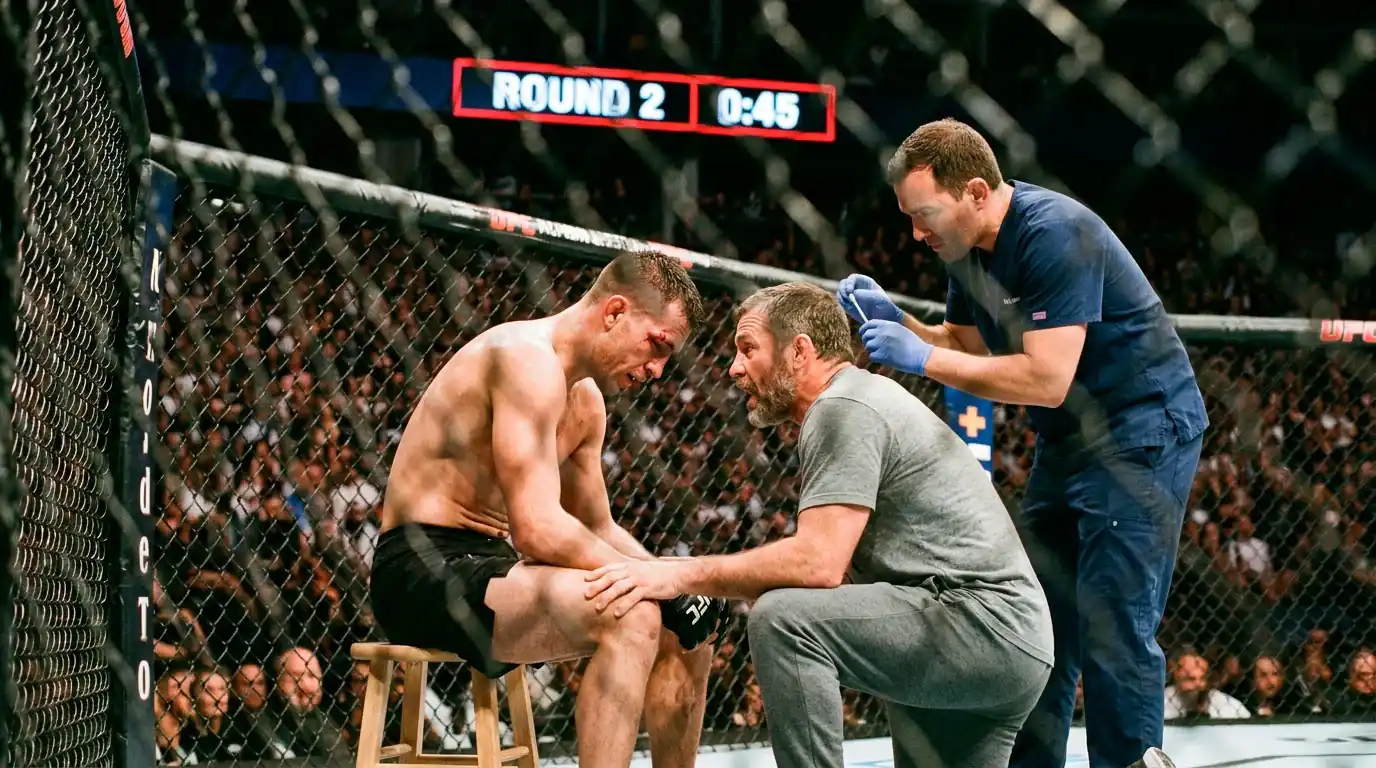
One detail worth mentioning for anyone trading live: the Apex atmosphere produces different between-round body language from fighters. The quieter crowd makes corner instructions clearer and raises the value of the between-round information if you watch carefully. I have found this more useful than the finish-rate adjustment in practice, because it changes how I read specific fighters’ chances of continuing rather than the statistical tilt.
What the venue effect actually means for a UK round bettor
The Apex-versus-arena question is a real one, but the answer is narrower than the folklore suggests. Submissions are modestly more common at Apex. Strike finishes are essentially the same. The round distribution within those finishes is not dramatically different — if anything, Apex submissions are distributed slightly later into the fight than arena submissions because the cage compression matters more in rounds two and three when fighters are more tired and more willing to engage on the ground.
For a UK round bettor pricing over-unders and combos, the practical workflow is: apply a small sub-rate upgrade for Apex bouts, leave KO rate alone, and factor in that the sub timing at Apex may favour the later rounds modestly. That is roughly a 1% to 2% shift in fair price across affected lines — small enough that nobody is going to get rich on the Apex effect alone, but meaningful enough to move specific tickets from “skip” to “back” and vice versa when the market has priced without the adjustment.
The rest of the venue conversation — the crowd, the lights, the atmosphere — is aesthetic rather than statistical. I enjoy the Apex for reasons that have nothing to do with betting edge, and I suspect most UK punters do too. The betting edge is real, measurable, and quite specific. Everything beyond that is vibes.
Does Apex cage size matter for finish rate?
Probably, but the effect is hard to isolate from fighter-quality composition. The submission rate at Apex is measurably higher than at arena events, and cage compression is a plausible contributor. KO and TKO rates are essentially identical across venues, which suggests the cage effect — if it exists — operates specifically on grappling exchanges rather than on strike finishes overall.
Are Apex undercards cheaper to price?
They are priced more thinly than arena main events in the sense that algorithmic pricing has less public data to lean on. This produces more combo-market inefficiency at Apex undercards than at comparable arena undercards, and it is one of the reasons careful round bettors spend a disproportionate share of their research time on Apex Fight Nights. The value lives in the submission-by-round combos most often.
Do arena main events see more decisions?
Modestly more, yes. Arena main events over-represent elite fighters who are harder to finish, and the overall finish rate at arena main events sits a few percentage points below the Apex main event rate. The decision differential is smaller than the submission differential and it is confounded by the fact that arena main events are more often championship bouts scheduled for five rounds, which also raises the raw decision rate.
Created by the ”Round Betting ufc” editorial team.