UFC KO-by-Round Betting: Division-Level Strike Finishes
 Available in US
Why the knockout market prices on rhythm, not on violence
The first thing to understand about KO-by-round betting is that the market is not really pricing violence. It is pricing rhythm. The fighter who lands a highlight-reel knockout once a year is usually overpriced on KO lines. The fighter who lands solid stoppages consistently across a consistent set of round windows is usually priced close to fair, which gives the disciplined bettor the better entry point.
I have spent ten years building mental shortcuts for KO-round pricing and the single most useful one is this: ignore the highlight reel. Look at the median outcome. A fighter whose last three stoppages all came in the second round has told you something meaningful about their cardio and timing. A fighter whose last three stoppages were one in each round has told you something different — that the finish can come from anywhere, which is actually worse for a specific-round combo.
This piece walks through how KO and TKO markets settle at UK books, the division-level KO rates that matter most for round pricing, how to compound single-round probabilities for “KO by round X or earlier” markets, and the pricing traps that hurt casual bettors most consistently. If you want the broader combo maths, read the combo pricing walkthrough before or alongside this one.
KO vs TKO at the settlement layer
The market almost always treats KO and TKO as a single method. When you see “fighter A to win by KO/TKO in round two” on a UK book, the settlement logic fires on any stoppage driven by strikes — whether the opponent lost consciousness outright, was saved by the referee under ground-and-pound, was pulled out by the corner, or was stopped by the doctor between rounds due to strike damage. That bundling is standard across UKGC-licensed operators.
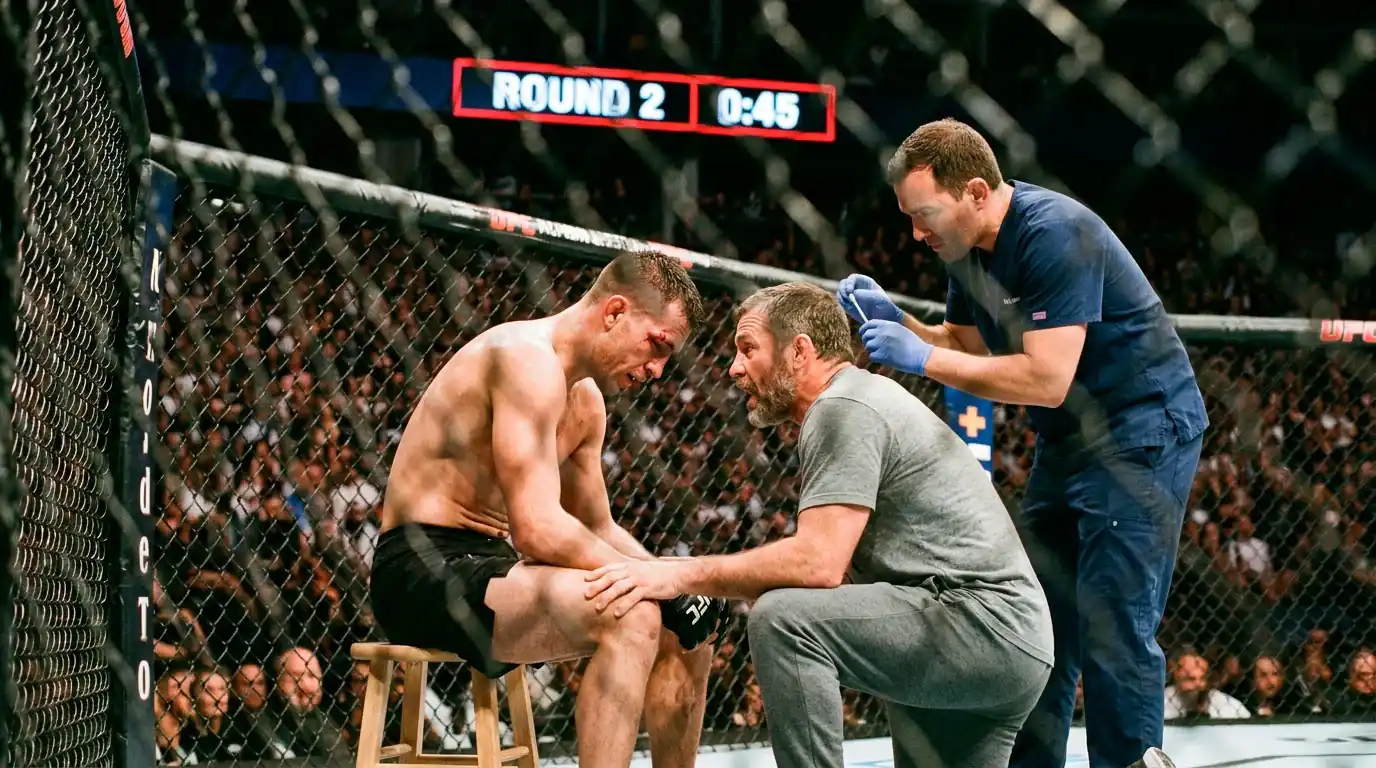
A few specific situations sit on the edge. A doctor stoppage between rounds for a cut that was unquestionably caused by a strike settles as TKO at most books. A doctor stoppage for a cut caused by an accidental clash of heads usually settles as no contest or technical decision depending on the round, not as a TKO. A corner retirement between rounds settles as TKO universally at UK books, even though the last official action in the round was usually not a clean finishing strike. These carve-outs rarely change the settlement of round-specific markets because the round where the stoppage becomes official is still the round where it happened — the round of the between-rounds decision, not the previous round.
Where it matters is for method-of-victory combos that pay only on KO or only on TKO as separate lines. Some books do split them, and those books will treat a corner retirement as TKO specifically, not KO. The settlement is usually right but worth checking once against your book’s rules page rather than discovering it during a dispute.
KO rates by division and why they matter
Heavyweight is the extreme case. KO rate sits close to 50% of all bouts, with only 28.6% of heavyweight fights reaching the judges across a sample of 885 bouts. That headline number does serious work on every heavyweight KO line you see. The round distribution of those KOs skews earlier than most divisions — round one accounts for the largest share because heavyweight power does not need much exchange to produce a finishing shot.
Light heavyweight sits at more than 43% of fights ending by strikes, with submission rates under 19%. Round distribution of light heavyweight KOs is similar to heavyweight with a slightly longer tail into rounds two and three. Middleweight hits 36.9% KO with almost 40% decisions — the turning point where striking finishes give way to grappling and decision outcomes. Welterweight sits at 32.7% KO with almost 47% decisions. Lightweight runs at 29.1% KO with 48% decisions. Flyweight drops to 24.6% KO with 53% decisions. Women’s strawweight bottoms out at 13.4% KO rate, which tells you that any short KO price at strawweight is almost certainly a losing bet no matter how convincing the favourite looks.
Women’s bantamweight has the highest KO rate among women’s divisions at 23.39%, which is meaningfully higher than flyweight or strawweight and worth remembering when you see a market treating all women’s divisions as broadly similar. Featherweight and bantamweight on the men’s side sit between welterweight and flyweight in KO rate, with distinct round distributions that lean slightly earlier in the fight than the middle-weight divisions. The full division-by-division breakdown lives in the finish rates calibration table, which is the reference I keep open during fight-week research.
Cumulative round probabilities and compounding
The interesting pricing work happens when books offer “KO or TKO before end of round X” as a separate market from “KO in round X exactly”. These are different markets and they price very differently.
“KO in round 1” pays only if the stoppage lands in round one. “KO before end of round 2” pays if the stoppage lands in round one or round two. The before-end-of-round-two probability is the sum of round-one-KO probability plus round-two-KO probability. If round one sits at 15% and round two sits at 10% for a given fighter, the before-end-of-round-two price should reflect roughly 25% implied probability, or fair odds around 4.00.
The compounding works because round-specific probabilities are conditioned on the fight not already being over. If round one has a 15% chance of producing a KO, there is an 85% chance the fight continues into round two. Round two’s conditional KO rate might be 12%, but the unconditional probability — the chance the fight ends in round two given that it started fresh — is 0.85 × 0.12 = 10%. Compounding those correctly gives you a fair price on “any round KO” and on “KO before end of round N” markets that the book can sometimes offer at slightly generous prices.
The round one KO rates for heavyweight push significantly above the all-card base rate. For lighter divisions, the round one KO rate is lower than you might expect because strike finishes take time to develop when power is lower. This shape of the distribution is one of the places where division-level data pays direct dividends at the pricing layer.
Reading the KO round line: what the shape of the numbers tells you
Pull up any card with a heavyweight main event and look at the KO-by-round prices. The pattern is nearly always the same. Round one sits shortest. Round two is longer. Round three is longer still. That cadence reflects the conditional probability structure and is usually correct, though the gradient between them is often steeper than it should be — meaning round two and round three at heavyweight are priced as though they are far less likely than round one, when actually the raw conditional probabilities flatten out more than the market acknowledges.
For lighter divisions, the pattern tends to flatten further. In a lightweight fight, round two is often the peak KO window because both fighters have survived the feel-out and begun exchanging at range with real intent. Books that price round two at a significant premium to rounds one and three are often reading the fight correctly. Books that price all three rounds at similar odds either genuinely do not have a read on where the finish is likely to come or have left room for the disciplined bettor to find the edge.
UFC favourites won 72% of their bouts in 2024. That broad efficiency tells you the market reads who wins very well. The inefficiency shows up in when and how they win, and the KO-by-round market is exactly where that inefficiency lives most consistently. Pair a favourite whose raw moneyline is fairly priced with a round-specific KO line that does not fully reflect their finishing rhythm and you have the template for a good round bet.
Translating numbers into better tickets
The habit that separates profitable KO-round bettors from break-even ones is the habit of writing down the fair price before looking at the book’s line. Start from the weight-class base rate, shade up or down for the specific fighters, distribute the total KO probability across the rounds using rough conditional weights, and compare your estimates to the published prices. When your number and the book’s number disagree, one of you is wrong. Sometimes it is you. Often enough for this to matter, it is the book.
Betting only when your number sits below the book’s implied probability — meaning the book’s price is longer than your model’s fair price — is the cleanest version of this workflow. Done across a season, the edge compounds. Done on individual cards in a burst of enthusiasm, it fades into variance. The KO-by-round market rewards the patient version and punishes the impulsive one, which is a fair description of most value-hunting in UFC betting more broadly.
Does a doctor stoppage settle as TKO?
Yes, at every UK book I have used, provided the cut or injury that triggered the stoppage was unquestionably caused by strikes rather than an accidental clash. A doctor stoppage between rounds for a strike-caused cut settles as TKO in the round where the fight did not resume. Accidental-cause stoppages follow the technical decision or no contest settlement path instead.
Are late-round KOs priced cheaply?
At heavyweight they often are, because the public narrative treats round one as the only real finish window. At lighter divisions late-round KOs are priced more carefully because round-two exchanges are genuinely the peak KO window for many lightweight and featherweight match-ups. As a general rule, round-two KO prices in the middle weight classes sit at closer-to-fair value than round-one KO prices at the same class.
Do KO rates fall in later rounds?
Unconditionally they fall, because most fights have already ended by then. Conditionally — given the fight has reached round three — KO rates remain roughly comparable to round two in most divisions, and at heavyweight they rise slightly as exhaustion exposes weaker defence. The distinction between conditional and unconditional KO rate is the single most important concept for anyone pricing compound KO markets like ‘KO before end of round X’.
Published by the Round Betting ufc team.